The London Breakout FOREX Trading Strategy

The London breakout FOREX trading strategy is used to trade the London trading session during the first few hours (1-3hrs) when the FOREX market opens in London.

You do not necessarily need any indicators for the London Breakout trading strategy, but you must be able to draw horizontal (support and resistance) lines on your FOREX chart. That is a very easy thing to do and you can learn all about it here.

Why Trade the London Session Breakout?

The London trading session is the biggest FOREX market mover as the most of the trading volume for currency trading is happening during this session.

What that means is that:

  • Whatever the trend direction during the first 1-2 hrs of London FOREX session is, determines what the trend would be for the remainder of the London session.
  • This trend might continue through to the New York trading session.

The volumes of trades and the amount of money that moves during the first few hours of the London FOREX market opening hours are HUGE, which creates some exciting trading opportunities.

So that explains the background of what and why of the London Breakout FOREX trading strategy. It’s all about catching the trendy moves to the upside or downside during the early hours of the London market opening.

Where and How to Place Your Breakout Orders?

The next thing you need to know is where to enter your trade order to trade the London Breakout.

Here is how to do that:

  • Identify the 3 previous candlesticks in the Asian session.
  • Find the high and the low of these 3 candlesticks because they form your breakout levels.
  • On the highest point of these three candlesticks draw a horizontal line. If price breaks above this line, it’s a buy signal.
  • On the lowest price point between these 3 candlesticks draw another horizontal line. If price breaks below this line, this is your sell signal.

See the image below as it makes it clear:

How To Close Your Trade

At the end of the London trading session you must close your trade, you don’t want to carry this position overnight. Even if it means you have a 10 pips profit or a 10 pips loss. Just do it. Never hang on your trade hoping for a few more pips in the New York trading session.

In FOREX trading Hope and Prayer have no place, you follow a system.
And also remember, there is always tomorrow.

Advantages of the London Breakout FOREX Trading Strategy

  • Very simple FOREX trading system.
  • No indicators needed and it’s a very simple price action trading system.
  • It’s a very easy trading strategy that even a stay-at-home mum or dad can do.
  • All you need to do is draw 2 horizontal lines based on the high and low of the previous 3 candlesticks in Asian trading session; they form your breakout levels on where you place your pending orders to catch a breakout.

Disadvantages of the London Breakout FOREX Trading Strategy

As usual, this is not a holy grail trading strategy. There will be times when the FOREX market may not move as expected and this can lead to trading losses.

Experience has shown that Mondays and Fridays are the worst days to trade FOREX, as the market usually is slow on Mondays and spiky on Fridays. You can either trade on these two days or avoid them, it’s up to you.

Happy trading!

Mindset – Every Worthy Goal Requires Self Discipline

Last time I posted on my blog was in March this year. Long time ago. Must admit, I feel guilty, hopefully you can forgive me. Of course, I could look for excuses like no time, too busy with trading FOREX, overwhelmed by this pandemic etc.

But it would not be the truth. The truth is the lack of self discipline. I didn’t stick to my plan. Guilty! Simple as that. Sounds familiar?

Then yesterday I saw this video and thought to myself: Yesss, Terri is right, this is what I need to do! Terri shares simple steps you can take that will help you to gain more self discipline!


The Art of “Feeling” the Forex Market

In Forex trading, one has to learn to gauge market sentiment, listen to what the charts are saying, and adjust accordingly.

More often than not, it’s also about getting the timing right. That’s why intuition plays a huge role. Not to be confused with taking impulsive trades based on gut feel. Forex trading demands a special type of intuition that many refer to as “feeling the market” or being “in the zone.”
Forex tradingIt’s that specific point in your Forex trading career. You have gained enough experience to label market behavior (trending, ranging, breaking out or consolidating). You know what trading setup you will take to tilt the odds slightly in your favor.

Examples:

You noticed that the market is trending, so you use moving averages.
You noticed that the market is retracing, so you use Fibonacci retracement levels.
You noticed that the market is ranging, so you mainly use support and resistance levels.
You noticed that the market is consolidating, so you wait for a breakout.

Did this just magically happen? Heck NO! Just like in any other art form, some are born with the natural talent while others acquire the skill. Either way, you arrived at this point because of constant refinement and deliberate practice.

Through these actions, you have learned to trust yourself and observe the Forex market in an analytical and “artful” way, and not merely by guessing.

You have found out that Forex trading is more of an art than an exact science. Also you have learned that there really is no clear “signal” or set of rules, that indicate that the market environment has changed.

Getting “in the zone” does not happen overnight. It takes time.

Just like in photography, where it takes tons of practice to get the perfect shot, Forex trading requires watching the charts every now and then, before you get to the point where you can instinctively “feel the market.”

This experience is necessary because it will help you understand why the market is behaving the way it is. It isn’t enough to go through the manual and learn all the technical aspects.

At some point, you need to put all this knowledge to work and try it out for yourself. By exposing yourself to the markets, you can gain the skills necessary to gauge market conditions and in the end, come up with your own conclusions.

By Dr. Pipslow

Source: BabyPips

.

.

Forex Trading – Japanese Candlestick Patterns Pt3

TRIPLE CANDLESTICK PATTERNS

I – Morning and Evening Stars

The morning star and the evening star are triple candlestick patterns that you can usually find at the end of a trend. They are reversal patterns that can be recognized through three characteristics.
ForexWe’ll use the Evening Star Pattern on the right as an example of what you may see:

#1 The first candlestick is a bullish candle, which is part of a recent uptrend.
#2 The second candle has a small body, indicating that there could be some indecision in the market. This candle can be either bullish or bearish.
#3 The third candlestick acts as a confirmation that a reversal is in place, as the candle closes beyond the midpoint of the first candle.

II – Three White Soldiers and Black Crows

The three white soldiers pattern is formed when three long bullish candles follow a DOWNTREND, signaling a reversal has occurred.
ForexThis triple candlestick pattern is considered as one of the most potent in-your-face bullish signals, especially when it occurs after an extended downtrend and a short period of consolidation.

The first of the three soldiers is called the reversal candle. It either ends the downtrend or implies that the period of consolidation that followed the downtrend is over.

For the pattern to be considered valid, the second candlestick should be bigger than the previous candle’s body. Also, the second candlestick should close near its high, leaving a small or non-existent upper wick. The last candlestick should be at least the same size as the second candle and have a small or no shadow.

The three black crows pattern is just the opposite of the three white soldiers. It is formed when three bearish candles follow a strong UPTREND, indicating that a reversal is in the works.

The second candle’s body should be bigger than the first candle and should close at or very near its low. The third candle should be the same size or larger than the second candle’s body with a very short or no lower shadow.

III – Three Inside Up and Down

The three inside up candlestick formation is a trend-reversal pattern that is found at the bottom of a DOWNTREND. This triple candlestick pattern indicates that the downtrend is possibly over and that a new uptrend has started.
ForexFor a valid three inside up candlestick formation, look for these properties:

#1 The first candle should be found at the bottom of a downtrend and is characterized by a long bearish candlestick.
#2 The second candle should at least make it up all the way up to the midpoint of the first candle.
#3 The third candlestick needs to close above the first candle’s high to confirm that buyers have overpowered the strength of the downtrend.

On the other side, the three inside down candlestick formation is found at the top of an UPTREND. It means that the uptrend is possibly over and that a new downtrend has started.

A three inside down candlestick formation needs to have the following characteristics:

#1 The first candle should be found at the top of an uptrend and is characterized by a long bullish candlestick.
#2 The second candle should make it up all the way down the midpoint of the first candle.
#3 The third candlestick needs to close below the first candle’s low to confirm that sellers have overpowered the strength of the uptrend.

Source: BabyPips

.

.

.

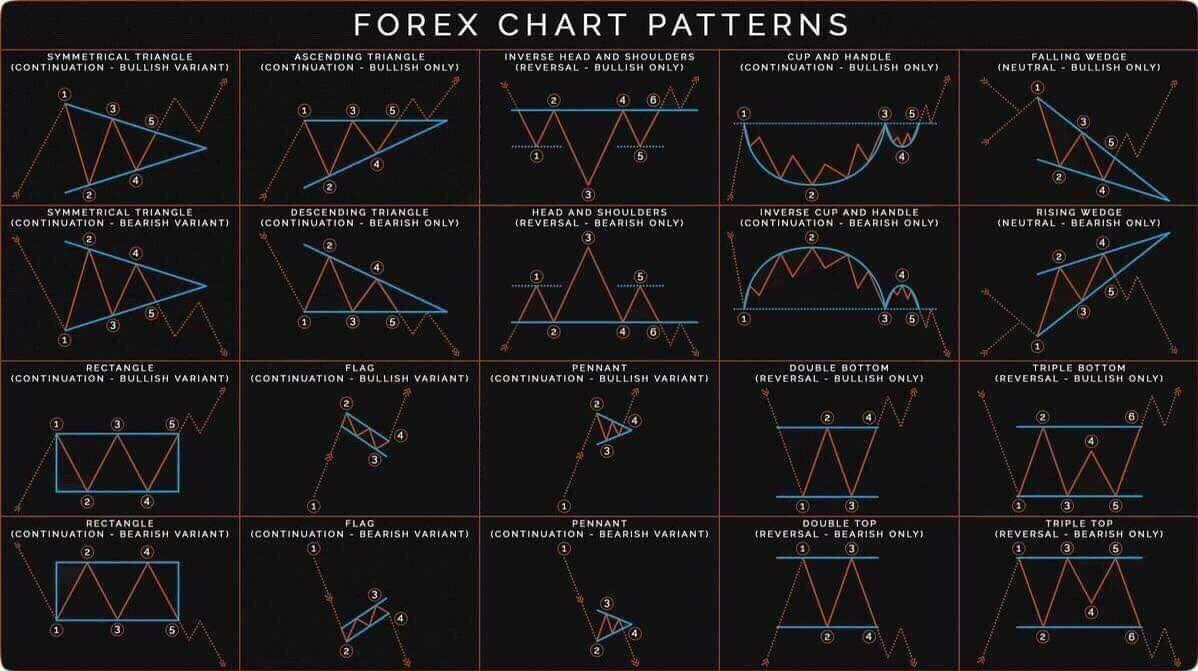
Forex Trading – Forex Chart Patterns Cheat Sheet

Here’s a little cheat sheet to help you remember all those Forex chart patterns and what they are signaling.

You can see listed the basic Forex chart patterns, when they are formed, what type of signal they give, and what the next likely price move may be. Check it out!

ForexForex

You never know when you’re gonna need to cheat!

The triangle formations (symmetrical, ascending, and descending) are not included in this cheat sheet. That’s because these chart patterns can form either in an uptrend or downtrend, and can signal either a continuation or reversal. Confusing, but that’s where practice and experience comes in!

As we all know, it’s tough to tell where the Forex market will breakout or reverse.

So what’s important is that you prepare well and have your entry/exit orders ready so that you can be part of the action either way!

Happy Trading!

Source: BabyPips


.

.

Forex Trading – Is it Worth it Concentrating on Chart Patterns?

Yes, you should be aware of them even if you don’t trade patterns as such. They demonstrate price action, support & resistance levels and simple chart dynamics like trends, and they are useful guides to market participants’ psychology and buying / selling preferences.

Forex

Chart patterns is the most interesting thing in the whole technical analysis. Actually, they are more useful than any other tools like indicators or candlestick patterns. They will help you to understand the situation and sometimes even to make relatively accurate assumptions on the upcoming price changes.

You can easily find detailed information on the most popular chart patterns. It would be interesting to save templates and then try to find them on charts. You can also create your own collection of chart patterns – this will give you better understanding of instruments you are trading.

Of course, indicators are important too, but in most of the cases they just provide additional confirmation for the signals provided by chart patterns, and the situation with candlestick patterns is nearly the same.

Another important point is that one can use the same chart patterns at any market, so this approach is very flexible. If you will find some books dedicated to chart patterns in commodities or stocks, you can use them too.

But don’t spend too much time on these things and the different names they have.

Know what a Doji, Shooting Star, or Hammer candle is. Know what a Head and Shoulders is. And otherwise, look for ‘M’ or ‘W’ structure to give signs of reversals and/or continuations. ‘M’ structure is obviously bearish – Highest High – higher low – lower high – lower low, and ‘W’ structure is bullish. Lowest low – Lower high – Higher Low, Higher high.

Forex Triangles

Know what a pennant is, a descending triangle, and an ascending triangle, and the way that price usually (although not always) breaks from these formations.

Source: BabyPips


.


.

Stop Waiting For That Perfect Forex Trade Setup!

When you’re risking your own money, do you feel the need to find that secret information that nobody yet knows or to find the perfect Forex trade setup?

Forex Trading

Some traders are so obsessed with trying to find the “perfect trade” that they end up not trading enough to get experience and develop the trader mindset, which in turn decreases the odds of long-term profitability.

Forex trading is not the line of work you want to be in if you’re a perfectionist!!!

You can plan a trade systematically only to end up losing money because an unforeseen event invalidates the trade setup that you thought was sooo perfect, slapping you in the face and forcing you to question your trading skills. That’s just the way the cookie crumbles!

While you don’t want to become a careless and impulsive Forex trader, you don’t want to be an extreme perfectionist either. Remember that there’s no such a thing as a “perfect setup” or a guaranteed profit.

Rather than looking for the “perfect” setup, just find a setup with a good probability of success. Yes, you might make less profit per trade (or even lose that trade), but you’ll actually take the risk and give yourself a chance to develop your skills, learn, and make a profit.

You may find that you prefer a “less-than-perfect” trade since you’re more relaxed, which tends to be more supportive of high performance than being stressed (which a perfectionist mindset tends to bring).

Forex trading is just like dating because it’s all about probabilities. You must make many trades (or kiss many frogs) to get the law of averages to work in your favor or to eventually score that big win.

As long as the setups are legitimate and you’re using sound money management and risk control to max out profits and cut losses, you’ll make enough trades to come out ahead. You’ll be able to get the losing trades “off your back” and focus on winning trades.

If you’re an unyielding perfectionist, you’ll always be on edge and will hardly be able to execute any trades. This will be your downfall  because you won’t be able to pull the trigger on Forex trades that were “less than perfect” but had a good chance of profitability.

Dare to be average and see what happens. A student who makes straight “A’s” may be smarter but the “C” student sitting behind him may be richer.

Source: BabyPips


.

.

Forex Trading – Japanese Candlestick Patterns Pt 1

On your journey to learn more about Forex trading, today you can read about basic Japanese candlesticks patterns.Forex TradingSpinning Tops
Japanese candlesticks with a long upper shadow, long lower shadow and small real bodies are called spinning tops.

The color of the real body is not very important. The pattern indicates the indecision between the buyers and sellers.
Forex TradingThe small real body (whether hollow or filled) shows little movement from open to close, and the shadows indicate that both buyers and sellers were fighting but nobody could gain the upper hand.

Even though the session opened and closed with little change, prices moved significantly higher and lower in the meantime.

– If a spinning top forms during an uptrend, this usually means there aren’t many buyers left and a possible reversal in direction could occur.
– If a spinning top forms during a downtrend, this usually means there aren’t many sellers left and a possible reversal in direction could occur.

Marubozu
Sounds like some kind of voodoo magic, huh? Fortunately, that’s not what it means. Marubozu means there are no shadows from the bodies.

Depending on whether the candlestick’s body is filled or hollow, the high and low are the same as its open or close. Check out the two types of Marubozus in the picture below.
Trading ForexA White Marubozu contains a long white body with no shadows. The open price equals the low price and the close price equals the high price.

This is a very bullish candle as it shows that buyers were in control the entire session. It usually becomes the first part of a bullish continuation or a bullish reversal pattern.

A Black Marubozu contains a long black body with no shadows. The open equals the high price and the close equals the low price.

This is a very bearish candle as it shows that sellers controlled the price action the entire session. It usually implies bearish continuation or bearish reversal.

Doji
Doji candlesticks have the same open and close price or at least their bodies are extremely short. A doji should have a very small body that appears as a thin line.

Doji candles suggest indecision or a struggle for turf positioning between buyers and sellers.

Prices move above and below the open price during the session, but close at or very near the open price.

There are FOUR special types of Doji candlesticks. The length of the upper and lower shadows can vary and the resulting Forex candlestick looks like a cross, inverted cross or plus sign.
Forex tradingWhen a Doji forms on your chart, pay special attention to the preceding candlesticks.

If a Doji forms after a series of candlesticks with long hollow bodies (like White Marubozus), the Doji signals that the buyers are becoming exhausted and weakening.

In order for price to continue rising, more buyers are needed but there aren’t anymore! Sellers are looking to come in and drive the price back down.
ForexIf a Doji forms after a series of candlesticks with long filled bodies (like Black Marubozus), the Doji signals that sellers are becoming exhausted and weak.

In order for price to continue falling, more sellers are needed but sellers are all tapped out! Buyers are foaming in the mouth for a chance to get in cheap.
ForexWhile the decline is sputtering due to lack of new sellers, further buying strength is required to confirm any reversal. Look for a white candlestick to close above the long black candlestick’s open.

Hopefully it will help you to know how to recognize different types of Japanese candlestick patterns and make sound trading decisions based on them.

Source: BabyPips


Main Trading Feeling – Greed or Fear

To my mind, greed is a bad thing. Greed may make trader to hold the position without any reason just because he wants it to make him money. Such trader would hold even loosing positions thinking that it “must” get him those money back. This is the most common problem of the greedy traders that would be better to avoid.
Forex TradingAt the other side, if your main trading feeling is fear, it would just make you to close your positions with the small profits or to avoid new trades at all. Anyway, you would no loose huge amount of money. For sure, too much fear could also cause under-performance.

Even experienced trader influenced by the fear could miss great trading opportunities one by one. Another point is that closing positions too early could influence the risk-reward ratio that requires profits to be larger than losses.

Both of these feelings, greed AND fear, are negative. Trader need to be able to change his behavior from aggressive to conservative, depending on current market conditions.

Source: Baby Pips


.

Your Worst Trades Can Help You Become a Better Forex Trader

In life we usually develop repetitive behavior. We develop daily routines that help us get through the day. And as creatures of habit, we also go through patterns in forex trading. Over time, we form a routine in the way we process and react to information thrown at us.
Forex TradingTry looking at the worst trade you’ve ever had in your trade journal. It’s not easy, I know, but could be a good lesson.

Review the trade setup that you saw, think about what went wrong, and ask yourself, “Why the heck did I ever take that trade in the first place? What was I thinking?!”

More importantly, “Was I even thinking?!”

You probably just took that trade automatically based on a familiar setup. In this case, your decision was a result of your own way of thinking rather than what the market was telling you.

Your worst trade isn’t necessarily the one where you’ve incurred your largest loss.

It can be in the form of a missed opportunity, when you hesitated to long to take what could’ve been your trade of the year, or when you locked in profits too early instead of letting it ride. You might’ve wimped out because of your fear of losing, even when the markets gave every indication that this next trade would be a winner.

Another negative thought pattern is when you become absolutely indifferent to losing that you end up blindly taking one trade after another just to make up for your losses.

In this case, you keep insisting that you’re right and you believe that you will eventually beat the market. Revenge trading turns into a nasty habit and could result in large drawdowns if not corrected.

The usual response to bad trades is just shrugging them off. Much like the memory of getting rejected by crushes in high school. It’s easier to simply push the memory of a bad trade at the back of our heads, and falsely reassure yourself that you’ll prepare better next time, and then move on to the next trade.

But THAT’S NOT ENOUGH!

You have to REALLY dig in into the problem and review the nitty-gritty of your bad trades. Otherwise, you run the risk of repeating your mistakes. No matter how painful or discouraging the task is, you must force yourself to open your trade journal and ask yourself questions like:

“Why did I take the trade?”

“Did I follow valid signals when I closed my position?”

You get the idea?

In forcing yourself to identify the emotions you felt when you made bad trading decisions, you might be able to see a negative pattern in your behavior and take actions to correct it.

Unlearning bad habits and trading practices can be difficult, but they will certainly bring you one step closer to controlling your emotions and becoming a better trader.

Source: Baby Pips


.

.

.

Forex Trading Abbreviations and Symbols

If you are a Forex trader beginner, than you need to know all the Forex trading abbreviations and Forex trading symbols, so you can fully understand what your fellow Forex traders are talking about. It might be a big help for you to make right decisions.

Forex Trading Abbreviations and Symbols
Forex trading
For example, today I was trading GA/ 

Happy Trading!


.

Forex Trading – More About Revenge Trading

Revenge trading is mainly driven by the fear of being wrong. It’s usually when a trader, coming from a particularly frustrating loss, decides to make up for it by being more aggressive in his/her next trades.

This is dangerous for your account for two main reasons. First, it forces you to throw your trading discipline out the window. It shifts your focus from your trading process and good risk management to trying to make enough money to recover your losses with less thought out trades.

Trading based on emotions and luck is not trading. It’s gambling. Without any risk management plan, it can bleed your account one trade at a time.
Revenge tradingIt’s also a lose-lose situation. If you lose a revenge trade, you deepen your drawdown with a trade that you had barely planned for.

Revenge trades come in many forms but the most common one is when traders take impulsive (and usually bigger) trades after a particularly frustrating loss in the hopes of making back the money they’ve lost.

Luckily, there are ways to recover from a bout of revenge trading.

Step Out and Clear Your Head After a Frustrating Loss
Do non-trading related activities and come back only once you’ve acknowledged that losing is part of the game.

Document the Reasons Why You Lost Your Trade
Identifying what went wrong with your trade and focusing on improving your trading process helps lessen the feeling that the market is against you.

Take Note of Your Triggers and Tells on Your Trading Journal
Do you do it when you’re trading big positions or when you got taken out by unexpected catalysts? Do you do usually bite your fingernails or scream at your cat before doing it? Knowing your triggers helps you prevent yourself from taking on more revenge trades.

Trust in Your System!
If you’ve tested your system and follow your trading plan 100%, then you won’t mind the losses much because you know that the end numbers will add up in your favor in the end.

Practice Risk Management
If you make risk management a habit, then you’ll have better trading discipline and are less likely to take impulsive trades. If you’re not used to it yet though, then you can start with following strict rules on position sizes and trade duration.

Remember that even the most consistently profitable traders have bad trading days. It’s all part of the game after all. Don’t take losses to mean that the market is against you. It doesn’t care about your feelings or how sound your trade ideas are. It’s not you, it’s just Forex trading.

By Dr. Pipslow

Source: Baby Pips


.

.

Why Trade Forex – Advantages Of Forex Trading

There are many benefits and advantages of Forex trading. Here below are just a few reasons why so many people are choosing this market.
Forex TradingNo Commissions
No clearing fees, no exchange fees, no government fees, no brokerage fees. Most retail Forex brokers are compensated for their services through something called the “spread“.

No Fixed Lot Size
In spot Forex, you determine your own lot, or position size. This allows traders to participate with accounts as small as $25 (although we’ll explain later why a $25 account is a bad idea).

Low Transaction Costs
The retail transaction cost (the bid/ask spread) is typically less than 0.1% under normal market conditions. For larger transactions, the spread could be as low as 0.07%. Of course, this depends on your leverage.

A 24-Hour Market
There is no waiting for the opening bell. From the Monday morning opening in Australia to the Friday afternoon close in New York, the Forex market never sleeps.

This is awesome for those who want to trade on a part-time basis because you can choose when you want to trade: morning, noon, night, during breakfast, or in your sleep.

No One Can Corner the Market
The foreign exchange market is so huge and has so many participants that no single entity (not even a central bank) can control the market price for an extended period of time.

Leverage
In Forex trading, a small deposit can control a much larger total contract value. Leverage gives the trader the ability to make nice profits, and at the same time keep risk capital to a minimum.

For example, a Forex broker may offer 50-to-1 leverage, which means that a $50 dollar margin deposit would enable a trader to buy or sell $2,500 worth of currencies. Similarly, with $500 dollars, one could trade with $25,000 dollars and so on.

However, remember that leverage is a double-edged sword.Without proper risk management, this high degree of leverage can lead to large losses as well as gains.

High Liquidity
Because the Forex market is so enormous, it is also extremely liquid. This is an advantage because it means that under normal market conditions, with a click of a mouse you can instantaneously buy and sell at will as there will usually be someone in the market willing to take the other side of your trade.

You are never “stuck” in a trade. You can even set your online trading platform to automatically close your position once your desired profit level (a limit order) has been reached, and/or close a trade if a trade is going against you (a stop loss order).

Low Barriers to Entry
You would think that getting started as a currency trader would cost a ton of money. The fact is, when compared to trading stocks, options or futures, it doesn’t. Online Forex brokers offer “mini” and “micro” trading accounts, some with a minimum account deposit of $25.

We’re not saying you should open an account with the bare minimum, but it does make Forex trading much more accessible to the average individual who doesn’t have a lot of start-up trading capital.

Free Stuff Everywhere!
Most online Forex brokers offer free “demo” accounts to practice trading and build your skills, along with free real-time Forex news and charting services.

Demo accounts are very valuable resources for those who are “financially hampered” and would like to hone their trading skills with “play money” before opening a live trading account and risking real money.

Source: Baby Pips


Forex

.

Forex Trading Newbie Tip

When you met your goal for the day… stop and smell the roses.
trading ForexRelax, take in your win. Demo trade if you must. Remember: this is a mental game. The market takes advantage of the greedy and feeds the patient. Also don’t forget to celebrate your victory.

Source: Scharlette Donald


.

What Forex Traders Do To Guarantee Their Own Failure

Did you know that the five deadliest factors that cause traders to fail are self-inflicted? Many traders self-sabotage their own trading and may not even be aware they’re doing it. When their account goes to zero, they have nobody to blame but themselves.

While it might be too late for these traders, fortunately, it’s not too late for you. We want to make sure that you don’t suffer from the same blind spots and can, hopefully, avoid sharing the same fate of a blown account.

To make it easier to remember, we call these negative factors, the “O’s of Trading“, and there are five of them.

What are the 5 “O’s”?
Forex traders
Overconfidence
Overconfidence isn’t simply the feeling that you can handle anything. Overconfidence is characterized by an inflated belief in one’s own trading skills.

Confidence is critical in becoming a successful trader. When you’re confident, you’re more likely to take risks or look for opportunities.

However, it’s one thing to believe that your trades can potentially be profitable, but it’s another thing to think that you know everything about the markets and that there’s no way for you to ever lose because all you do is win.

While confidence is necessary, too much confidence can have negative consequences.

To minimize the effects of the overconfidence effect, you must take time to truly understand yourself and what you are capable of achieving. Most importantly, you must ALWAYS consider the possibility that you are WRONG, to listen to new evidence, and to know when to change your mind!

Overtrading (Including Revenge Trading)
Overtading is when you are trading too frequently, taking extremely large trades, and/or taking uncalculated risks.

Successful traders are extremely patient. Quality setups take time to materialize, so they remain patient and wait for confirmation.

It doesn’t matter if the setup takes two hours or two weeks to take shape. What matters is protecting their capital so they will wait until the odds are more in their favor before entering.

You will know if you are overtrading. If you close a trade for a loss and deep down, you feel like you shouldn’t have taken the trade, then you’re GUILTY of overtrading.

For example, when you’re supposed to trade from the daily chart, do you find yourself still looking at the lower time frames like the 5-minute chart and “discovering” better trades there?

Do you find yourself spending hours staring at charts and trying to “force” a trade with a “good enough” setup?

Revenge Trading
Letting your emotions get to you regarding your trading performances is dangerous. When it comes to trading, the head, not the heart, should be in charge.

When you suffer a large loss, or a series of losses, within a short span of time, you might be tempted to “revenge trade”. You want to “get back at the market”.

Revenge trading is when you jump back into a new trade right after taking a loss because you believe that you can quickly flip the loss back into a profit.

When you start thinking like this, your state of mind is not objective anymore. You become more prone to making even more trading mistakes, which results in you losing even more money.

Trading is a game of patience. Traders who wait for quality setups and sit on their hands in between are the ones who will end up profitable in the long run. Focus on the process. Not on the profits.

Overleveraging
In Forex trading, leverage means that with a small amount of capital in your account, you can open and control a much larger trading position.

For example, with a $1,000, your broker might allow you to open a $100,000 position. This is 100:1 leverage. The advantage of using leverage is you can magnify gains with a limited amount of capital. The disadvantage of leverage is that you can also magnify your losses and quickly blow your account!

Overexposure
When you have multiple positions open in your trading account and each position consist of a different currency pair, always make sure you’re aware of your RISK EXPOSURE.

For example, on most occasions, trading AUD/USD and NZD/USD is essentially like having two identical trades open because they usually move in a similar manner.

Even if there are two valid trade setups in both pairs, you may not want to take both. Instead, it might make more sense to pick ONE out of the two setups.

You might believe that you’re spreading or diversifying your risk by trading in different pairs, but many pairs tend to move in the same direction. So instead of reducing risk, you are magnifying your risk! Unknowingly, you are actually exposing yourself to MORE risk. This is known as overexposure.

Unless you plan on trading just one pair at a time, it’s crucial that you understand how different currency pairs move in relation to each other. You need to understand the concept of currency correlation.

Overriding Stops
Stop losses are pending orders you enter that effectively close out your trading position(s) when losses hit a predetermined price.

It might be psychologically difficult for you to acknowledge being wrong, but swallowing your pride can keep you in the game longer.

In the heat of battle, what often separates the long-term winners from the losers is whether or not they can objectively follow their predetermined plans.

Traders, especially the more inexperienced ones, often question themselves and lose that objectivity when the pain of losing kicks in. Negative thoughts appear such as, “I’m already down a lot. Might as well hold on. Maybe the market will turn right here.” Wrong!

If the market has reached your stop, your reason for the trade is no longer valid and it’s time to close it out. Do not widen your stop. Even worse, do not override or remove your stop and “Let it ride!”

Increasing your stop only increases your risk and the amount you will LOSE! If the market hits your planned stop then your trade is done. Take the hit and move on to the next opportunity.

Source: Baby Pips


.

.

.

Forex Trading – Trade Forex Like a Hunter

In many trading-related books we often see the markets become associated with a jungle. And why not? Every day traders battle it out with animal references such as the bulls and the bears, the hawks and the doves, and the wolves and the sharks.

This is likely why traders love referencing themselves as the modern-day hunters. Some say that they’re like the cheetahs who catch their prey using sheer speed while others see themselves as crocodiles who lie in wait for a big, fat catch.
forex trading
So what does it take to become a successful hunter? And for traders, what does it take to consistently make pips?

1. Know Your Prey
When a lion wants to eat a buffalo, it doesn’t attack the first one it sees. It studies and analyses the herd’s behavior patterns and looks for its potential weaknesses. By the time the lion is ready to strike, it already knows what makes the herd tick, where to attack, and how to get the fattest buffalo with the least amount of effort.
forex trading
Like in the lion’s case, it’s essential for traders to collect data before striking. Before you enter a EUR/USD short, for example, you must first know which factors can influence its price action and which levels present the best reward-to-risk ratios.

Ask yourself questions such as “Which economic reports does the pair usually respond to? When does the pair move the most? What factors can shift its current trend?” Collect data and turn them into probabilities.

2. Wait for the Best Opportunity to Strike
Once you’ve gathered information on your prey, use it to your advantage by striking at the best possible opportunity. After all, hunters usually just get one chance.

Maximize your gains while minimizing your effort and your risk. The difference between an average and a skilled hunter is that the skilled hunter waits until the odds are overwhelmingly in his favor.

3. Execute According to Plan
For traders, the time to think about what could happen and what you would do in an alternate scenario has passed. In this stage, it’s all about just doing what needs to be done.

Be quick, aggressive, accurate, and confident in your execution. Don’t let fear and greed get in the way of your performance. Of course, it would help if you’ve already back and forward tested your trading strategy and that you’re confident that the numbers will add up in the end.

4. Monitor and Adjust
At any given day a leopard could encounter an extraordinarily resilient gazelle or a similar scenario that could change the outcome of its attack. Should the leopard use a different approach? Or should it abort its plan and wait for another opportunity?

If the actual trading scenario is different from the one you initially envisioned, then it’s time to make adjustments. The first step is to consult your play book for any alternative strategies you might have written or executed before. Then, weigh the outcomes of your options.

Should you cut your losses or let your profits run? Should you add to your position or close it and wait for another opportunity? Whatever your decision is, remember to choose the path of minimum risk and maximum gains.

5. Learn and Earn
The best hunters are ones that have learned the most from their previous experiences. In the jungle, you eat what you kill.

As in the jungle, the consistently profitable traders are not the ones who have the most trades, but those who have learned from their experiences and continue to improve their skills with each trade.

One way to speed up your learning process is to engage in deliberate practice. The process of journaling, recording, and reviewing your trades turns one experience into many and makes it easier to correct your mistakes.

Surviving the Forex jungle doesn’t require expensive tools or a fancy trading course. Sometimes it just takes simple processes such as the one stated above, repeated day in and day out, to become slowly but consistently profitable.

By Dr. Pipslow

Source: BabyPips

Images: Vera J.

.

.

Forex Trading – The Best Time to Trade Forex

Currency trading is unique because of its hours of operation. The week begins at 6 p.m. EST on Sunday and runs until 5 p.m. EST on Friday. Not all hours of the day are equally good for trading. The best time to trade is when the market is most active.

When more than one of the four markets are open simultaneously, there will be a heightened trading atmosphere, which means there will be greater fluctuation in currency pairs.
Forex Trading Hours
When only one market is open, currency pairs tend to get locked in a tight pip spread of roughly 30 pips of movement. Two markets opening at once can easily see movement worth of 70 pips, particularly when big news is released.

Overlaps in Forex Trading Times
The best time to trade Forex is during overlaps in trading times between open markets. Overlaps equal higher price ranges, resulting in greater opportunities. Here is a closer look at the three overlaps that happen each day:

U.S./London (8 a.m. to noon): The heaviest overlap within the markets occurs in the U.S./London markets. More than 70% of all trades happen when these markets overlap because the U.S.Dollar and the Euro are the two most popular currencies to trade, according to Lien. This is the most optimal time to trade since volatility is high.

Sydney/Tokyo (2 a.m. to 4 a.m.): This time period is not as volatile as the U.S./London overlap, but it still offers a chance to trade in a period of higher pip fluctuation. EUR/JPY is the ideal currency pair to aim for, as these are the two main currencies influenced.

London/Tokyo (3 a.m. to 4 a.m.): This overlap sees the least amount of action of the three because of the time (most U.S.-based traders won’t be awake at this time), and the one-hour overlap gives little opportunity to watch large pip changes occur.

Impact of News Releases on Forex Markets
While understanding the markets and their overlaps can aid a trader in arranging his or her trading schedule, there is one influence that should not be forgotten: the release of news.

A big news release has the power to enhance a normally slow trading period. When a major announcement is made regarding economic data – especially when it goes against the predicted forecast – currency can lose or gain value within a matter of seconds.

You will find people who do technical analysis only and they kill it very well, but they will all tell you how the news killed their trades.
Crash1
Even though dozens of economic releases happen each weekday in all time zones and affect all currencies, a trader does not need to be aware of all of them. It is important to prioritize news releases between those that need to be watched versus those that should be monitored.

Source: Investopedia


.

.

Trading Forex – Balance of Patience and Education

Wondering how to trade Forex successfully? Start with this: Set up a portfolio for yourself by choosing pairs to trade. Accumulate as much information based on those pairs, both historically and present.
Trading ForexYou will have more direction as to why your pairs behave the way they do and why it moves in that direction. You will understand what affects it, positively and negatively.

You will be in a more stronger position as you will know why you are placing a trade. Even if it goes negative for a while and then ends up positive, you are trading based on the reality of the trading world.

Any other way will be considered gambling for me personally. Everybody is different.

You will find people who do technical analysis only and they kill it very well, but they will all tell you how the news killed their trades.

So, when money is on the line, you need to know why you are departing with it until further notice or permanently if something goes wrong. Then have the discipline to make it back with a balance of patience and education.


.

.